What the hell are you on about?
My roomie has this habit of spontaneously launching questions in all situations and contexts. I, on the other hand, have this habit of answering or trying to answer all questions that I come across. This means that more than once my roomie has made me embark into extracurricular research in order to answer things that I could not answer sufficiently well right away.
So, while in the midst of one of our usual QA exchanges (this one on Christmas day) he asked me: "Since December 25 is Jesus' birthday and the Gregorian calendar (the western world's calendar) uses the instant of Jesus' birth as the beginning of time/calendar keeping, how come January the 1st is not the Christmas day?" Now, although the obvious answer to that is that due to an older convention December 25 has traditionally been the day of Christmas and it could not change, I immediately felt that I could not fully explain the story behind the particular date choices of December 25 and January 1 as the dates marking the days with the specific and special meaning that they presently have (at least for Christians).
I therefore decided to do some research. This research took me on a 3-day trip that deals with time conventions, different calendar systems, astronomy, pagan folklore, history, radioactivity, the Holy Bible and a bunch of other loosely but interestingly interrelated subjects that surely made my effort worthwhile, especially if the fun I had is to be counted.
The result of this short but turbocharged endeavor is this page on which I have attempted to lay out, in a taxonomically sound way, all the fascinating information that I gathered from a multitude of sources (listed at the end of this page). There is even a script (and a listing of the algorithm) that will calculate the weekday on which you were born given your Gregorian date of birth (DOB) in American layout, i.e. month/day/year, all numbers.
This page is not very focused towards a specific goal or subject (thus the 'melt' in the page's title - however my roomie's question is eventually answered); it rather documents my exploration of the involved issues and describes and explains various aspects of them in a way that is as trustworthy and scientifically sound as I could make it in such a short time. I do not speculate and I did not use any sources from books or sites that can be considered untrustworthy. So here we go!
Time
Time, period during which an action or event occurs; also, a dimension representing a succession of such actions or events. Time is one of the fundamental quantities of the physical world, being similar to length and mass in this respect. Three methods of measuring time are in use at present. The first two methods are based on the daily rotation of the earth on its axis. These methods are determined by the apparent motion of the sun in the sky (solar time) and by the apparent motion of the stars in the sky (sidereal time). The third method of measuring time is based on the revolution of the earth around the sun (ephemeris time).
Scientific Standards of Time
Until 1955, the scientific standard of time, the second, was based on the earth's period of rotation and was defined as 1/86,400 of the mean solar day. When it was realized that the earth's rate of rotation was irregular and also slowing down, it became necessary to redefine the second. In 1955 the International Astronomical Union defined the second as being 1/31,556,925.9747 of the solar year in progress at noon December 31, 1899. The International Committee on Weights and Measures adopted the definition the following year.
With the introduction of atomic clocks - specifically, the construction of
a high-precision cesium beam atomic clock in 1955 - more accurate measurement
of time became possible. This atomic clock is tuned to the resonant frequency
of the transition energy between two energy states of the cesium-133 atom.
In 1967 the measurement of the second in the International System of Units
was officially defined as the duration of 9,192,631,770 periods of the radiation
corresponding to the transition between two hyperfine levels of the ground
state of the cesium-133 atom.
Current Time Scales
There are two major time scales currently in use: UT1 and UTC. There are other time scales too but they are used for special purposes. Such time scales are the astronomically ultra accurate UT2, and the older and less accurate UT0 which does not take under consideration effects such as those of the 'polar motion'. 'Polar motion' refers to the phenomenon of the displacement (wobbling actually) of the earth's axis of rotation with all the complexity that this brings to the rotational motion of the earth.
UTC is the one currently reflecting civil time in Western countries. UT1 is astronomically determined and reflects the current astronomical situation (e.g. time it takes for a full revolution of the earth - what we call 'earth day'). UTC is an atomic time scale based on atomic phenomena and accurately kept by vast clocks consisting of dozens of atomic clocks in separate environmentally controlled chambers that are all averaged in order to produce the final UTC time count.
US Time, the Real Deal!
The official United States time is determined by the Master Clock at the U. S. Naval Observatory (USNO). The Observatory is charged with the responsibility for precise time determination and management of time dissemination.
Modern electronic systems, such as electronic navigation or communication systems, depend increasingly on precise time and time interval (PTTI). Examples are the ground-based LORAN-C navigation system and the satellite-based Global Positioning System (GPS). Navigation systems are the most critical application for precise time. GPs, in particular, is widely used for navigating ships, planes, missiles, trucks, and cars anywhere on Earth. These systems are all based on the travel time of electromagnetic signals: an accuracy of 10 nanoseconds (10 one-billionths of a second) corresponds to a position accuracy of about 3 meters (or 10 feet). The importance of accurate time keeping is therefore immense if we want to avoid gross mistakes in position coordinates determination.
The USNO must maintain and continually improve its clock system so that it can stay one step ahead of the demands made on its accuracy, stability and reliability. The present Master Clock of the USNO is based on a system of some 60 independently operating cesium atomic clocks and 7 to 10 hydrogen maser atomic clocks. These clocks are distributed over 20 environmentally controlled clock vaults, to ensure their stability. By automatic inter-comparison of all clocks every 100 seconds, a time scale is computed which is not only reliable but also extremely stable. Its rate does not change by more than about 100 picoseconds (.0000000001 seconds) per day from day to day.
On the basis of this computed time scale, a clock reference system is steered to produce clock signals which serve as the USNO Master Clock. The clock reference system is driven by a hydrogen maser atomic clock. Hydrogen masers are extremely stable clocks over short time periods (less than one week). They provide the stability and reliability needed to maintain the accuracy of the Master Clock System.
Very Long Baseline Interferometry (VLBI) is used to determine Universal Time (UT1) based on the rotation of the Earth about its axis. VLBI is an advanced astronomical technique of observing extra-galactic sources (typically quasars) with radio telescopes. The information gained using VLBI can be used to generate images of the distant radio sources, measure the rotation rate of the Earth, the motions of the Earth in space, or even measure how the tectonic plates where the telescopes are located are moving on the surface of the Earth. Measuring the Earth's rotational motion is critical for navigation. The most accurate navigation systems rely on measurements using satellite systems which are not tied to the Earth's surface. These systems can provide a position accurate to a about a meter (few feet), but the position of the Earth relative to the satellites must also be known to avoid potentially far larger errors.
The US Naval Observatory has been in the forefront of timekeeping since the early 1800s. In 1845, the Observatory offered its first time service to the public: a time ball was dropped at noon. Beginning in 1865 time signals were sent daily by telegraph to Western Union and others. In 1904, a US Navy station broadcast the first worldwide radio time signals based on a clock provided and controlled by the Observatory.
A time of day announcement can be obtained by calling 202-762-1401 locally in the Washington area. For long distance callers the number is 900-410-TIME. The latter number is a commercial service for which the telephone company charges 50 cents for the first minute and 45 cents for each additional minute. Australia, Hong Kong, and Bermuda can also access this service at international direct dialing rates. You can also get time for your computer by calling 202-762-1594. Use 1200 baud, no parity, 8 bit ASCII. For computer users the NIST.gov site offers a nifty utility program that will adjust your computer's clock according to the time kept by the NIST atomic clock.
Interscale issues
The UT1 day consists of a number of astronomical seconds that is of course equal to the number of UTC (aka SI) seconds in a UTC day (24x60x60 SI seconds). However, if we express the UT1 day in SI seconds (the kind of seconds that the UTC scale and civilians use) then the number of seconds in an astronomically determined earth day is slightly higher than the number of SI seconds in a standard UTC day which is always 24x60x60 SI seconds long.
This curious discrepancy is due to the fact that the earth's rotation keeps on an overall decelerative trend over time mainly due to the action of tides and their effect on the angular momentum of the earth. This means that the UT1 time count in SI seconds is a count that slowly and irregularly (irregularly because of other astronomical phenomena like interplanetary gravitational influences) yet surely gets more and more ahead of the standard UTC time count of SI seconds. This is what prompted the introduction of the 'leap second' concept. The 'leap second' is inserted in irregular intervals in order to make sure that the |UT1 - UTC| absolute difference is never larger than 0.9 SI seconds.
The decision of when to introduce a leap second in UTC is the responsibility of the International Earth Rotation Service (IERS) (See links at the end of this page). According to international agreements, first preference is given to the opportunities at the end of December and June, and second preference to those at the end of March and September. Since the system was introduced in 1972, only dates in June and December have been used. The last leap second was added on Jan 1 1999 and a new one is currently imminent.
Time Dilation
Time is not a physical constant, although the passage of time in any one place can be measured with great accuracy and precision. The effect of motion and gravity on time is that it is dilated or expanded. In 1905 Albert Einstein formulated the effect of motion on time in his special theory of relativity, and in 1917 he formulated the effect of gravity on time in his general theory of relativity.
These effects were observed in experiments conducted in the 1960s and 1970s. In one such experiment in 1971, atomic clocks were carried on two high-speed aircraft. One traveled eastward, that is, in the rotational direction of the earth, and one westward. After the flight, the onboard clocks were found to have either lost or gained time (relative to a ground-based atomic clock) depending on their direction of travel, an effect of motion, and their altitude, an effect of gravity. The results confirmed the predictions made in Einstein's theories of relativity.
Calendars
A calendar is a system for fixing the beginning, length, and divisions of the year and arranging days and longer divisions of time (e.g. weeks and months) in a definite order.
Etymology: Middle English calender, from Old French calendier, from Late Latin kalendrium, from Latin, 'account book', from kalendae, calends (from the fact that monthly interest was due on the calends - see the 'Roman Calendar' for details on what 'Calends' stood for).
All civilized peoples and even those which seem to be only just emerging from utter barbarism keep some kind of record of the flight of time and are prone to recognize certain days, recurring at regular intervals, as days of special rejoicing or mourning, or occasions for the propitiation of the powers of the unseen world. Calendars are born quite intuitively.
Astronomical basis of calendars
Calendars are normally based on astronomical events, and the two most important astronomical objects are the sun and the moon. Their cycles are very important in the construction and understanding of calendars. Our concept of a year is based on the earth’s motion around the sun. The time from one fixed point, such as a solstice or equinox, to the next is called a tropical year. Its length is currently 365.242190 days, but it varies. Around 1900 its length was 365.242196 days, and around 2100 it will be 365.242184 days. Our concept of a month is based on the moon’s motion around the earth, although this connection has been broken in the calendar commonly used now. The time from one new moon to the next is called a synodic month, and its length is currently 29.5305889 days, but it varies. Around 1900 its length was 29.5305886 days, and around 2100 it will be 29.5305891 days.
Note that these numbers are averages. The actual length of a particular year may vary by several minutes due to the influence of the gravitational force from other planets. Similarly, the time between two new moons may vary by several hours due to a number of factors, including changes in the gravitational force from the sun, and the moon’s orbital inclination. Also note that the earth's rotation is slowly decelerating and thus the duration of a day is becomes longer (more on this later). It is unfortunate that the length of the tropical year is not a multiple of the length of the synodic month. This means that if we want to keep 12 months in our year, the relationship between our month and the moon cannot be maintained.
What are equinoxes and solstices?
Equinoxes and solstices are frequently used as anchor points for calendars.
For people in the northern hemisphere:
- Winter solstice is the time in December when the sun reaches its southernmost latitude. At this time we have the shortest day. The date is near 21 December.
- Summer solstice is the time in June when the sun reaches its northernmost latitude. At this time we have the longest day. The date is near 21 June.
- Vernal equinox is the time in March when the sun passes the equator moving from the southern to the northern hemisphere. Day and night have approximately the same length. The date is near 20 March.
- Autumnal equinox is the time in September when the sun passes the equator moving from the northern to the southern hemisphere. Day and night have approximately the same length. The date is near 22 September.
For people in the southern hemisphere these events are shifted half a year. day: time it takes for a full earth revolution around its axis
Numbering conventions
Why should January the 1st mark the beginning of a new year?
Julius Caesar introduced his calendar (the Julian calendar which was the precursor of today's Gregorian calendar) in 45 BC. He also made 1 January the start of the year (more details later). Note that at that time December 25 did not have any special meaning as a date for the early Christians.
The Byzantine Empire used a year starting on 1 Sep
How do we number the years?
Conventions over the numbering of years also differ in various calendar systems. The issue is: should we start counting from 0 or should we start from 1?
When people started dating years before 754 AUC using the term “Before Christ”, they let the year 1 BC immediately precede AD 1 with no intervening year zero. Note, however, that astronomers frequently use another way of numbering the years BC. Instead of 1 BC they use 0, instead of 2 BC they use -1, instead of 3 BC they use -2, etc.
Which is the year used as the beginning of year counting?
The Byzantine Empire did not’t count years since the birth of Christ. Instead, they counted years since the creation of the world which they dated to 1 September 5509 BC. Since about 1600 most countries have used 1 January as the first day of the year. Italy and England, however, did not make 1 January official until around 1750.
In about AD 523, the papal chancellor, Bonifatius, asked a monk by the name of Dionysius Exiguus to do a lot of work. Dionysius Exiguus (in English known as Denis the Little) was a monk from Scythia, he was a canon in the Roman curia, and his assignment was to prepare calculations of the dates of Easter. At that time it was customary to count years since the reign of emperor Diocletian; but in his calculations Dionysius chose to number the years since the birth of Christ, rather than honor the persecutor Diocletian. Dionysius (wrongly) fixed Jesus’ birth with respect to Diocletian’s reign in such a manner that it falls on 25 December 753 AUC (ab urbe condita, i.e. since the founding of Rome), thus making the current era start with AD 1 on 1 January 754 AUC (1st Jan was already accepted as the conventional start of the year at the time of Dionysius).
How Dionysius established the year of Christ’s birth is not known (a couple of theories later on). Jesus was born under the reign of king Herod the Great, who died in 750 AUC, which means that Jesus could have been born no later than that year. Dionysius’ calculations were disputed at a very early stage.
How did Dionysius date Christ’s birth? There are quite a few theories about this and many of the theories are presented as if they were indisputable historical fact. Here are two theories that are considered likely:
- According to the Gospel of Luke (3 : 1 & 3 : 23) Jesus was “about thirty years old” shortly after “the fifteenth year of the reign of Tiberius Caesar”. Tiberius became emperor in AD 14. If you combine these numbers you reach a birthyear for Jesus that is strikingly close to the beginning of our year reckoning. This may have been the basis for Dionysius’ calculations.
- Dionysius’ original task was to calculate an Easter table. In the Julian calendar, the dates for Easter repeat every 532 years (more on that later on). The first year in Dionysius’ Easter tables is AD 532. Is it a coincidence that the number 532 appears twice here? Or did Dionysius perhaps "fix" Jesus’ birthyear so that his own Easter tables would start exactly at the beginning of the second Easter cycle after Jesus’ birth?
So, was Jesus born in the year 0?
No. There are two reasons for this:
- There is no year 0.
- Modern studies show that Jesus was probably born before 4 BC.
The concept of a year “zero” is a modern myth and it is closely related to the history of the number "zero". Roman numerals do not have a figure designating zero, and treating zero as a number on an equal footing with other numbers was not common in the 6th century when our present year reckoning was established by Dionysius Exiguus. Dionysius let the year AD 1 start one week after what he believed to be Jesus’ birthday. Therefore, AD 1 follows immediately after 1 BC with no intervening year zero. So a person who was born in 10 BC and died in AD 10, would have died at the age of 19, not 20.
Furthermore, Dionysius’ calculations concerning the year of birth of Jesus were wrong. The Gospel of Matthew (more on that later on) tells us that Jesus was born under the reign of king Herod the Great, and Herod died in 4 BC. It is likely that Jesus was actually born around 7 BC. The date of his birth is unknown; it may or may not be 25 December.
Does the stuff you just told us about numbering and the year zero somehow relate to the Y2K celebration travesty?
It sure does. The turn of the millennium was celebrated one year early just because the transition from the number 1999 to the number 2000 is more spectacular than the transition from 2000 to 2001. Other than that we are still civilized and well educated people and look down to 'lowly' bushmans fascinated by shiny coke bottles.
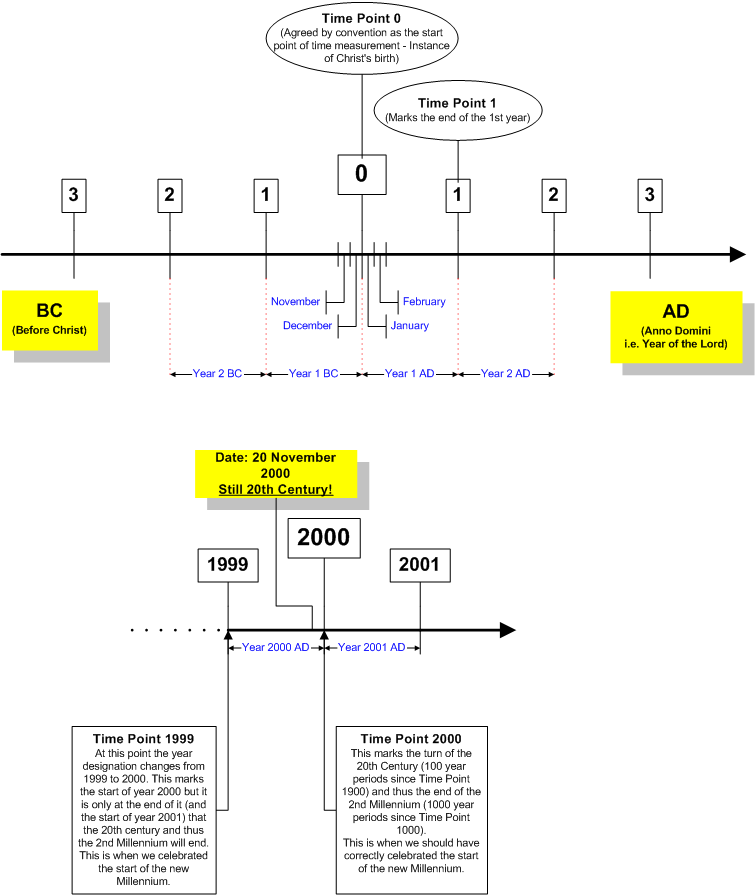
The first millennium started in AD 1, so the millennia are counted in this manner:
-
1st millennium: 1 - 1000
-
2nd millennium: 1001 - 2000
-
3rd millennium: 2001 - 3000
Thus, the 3rd millennium and, similarly, the 21st century started on 1 Jan 2001.
Here is a cool diagram that I put together in order to better explain the issue. As you can see, there is no year 0, just what I termed as "time point" 0.
What do AD, BC, CE, and BCE stand for?
Years before the birth of Christ are in English traditionally identified using the abbreviation BC (“Before Christ”). Years after the birth of Christ are traditionally identified using the Latin abbreviation AD (“Anno Domini”, that is, “In the Year of the Lord”). Some people, who want to avoid the reference to Christ that is implied in these terms, prefer the abbreviations BCE (“Before the Common Era” or “Before the Christian Era”) and CE (“Common Era” or “Christian Era”).
Calendar time divisions
Day
Day is the period of time required for one rotation of a celestial body, especially the earth, on its axis. This period is shorter or longer depending on whether the sun or another star is used as a reference point; thus, the sidereal day - the time it takes for the earth to rotate once relative to a star not the sun - is about 4 min shorter than the mean solar day. The solar day, measured by the interval between meridian passages of the sun, varies in length because of the variation in speed of the earth in its orbit. In consequence, the length of the solar day is averaged over the period of a year, and the mean solar day thus obtained is used for all civil and many astronomical purposes.
Each type of day is divided into exactly 24 hours that vary in length proportionately to the respective type of day. The civil day now begins at midnight, local time. In ancient times, the Babylonian day began with sunrise and with sunset among the Athenians and Jews. The day is still often regarded as starting with sunset in ecclesiastical (particularly Jewish ecclesiastical) usage; until recently, the astronomical day started at noon, and the Julian day (day of the Julian calendar, more details about the Julian calendar later) still starts at noon.
In common usage day, as distinct from night, is the period of natural light between dawn and dusk. The period of daylight, most nearly constant near the equator, varies with the latitude and the season, reaching a maximum of 24 hr in the polar zones in summer, a phenomenon known as the midnight sun.
Week
The origin of the week as a time division does not seem to be based on a natural/astronomical phenomenon. However the week seems to be very ancient as a time division and probably draws its roots from ancient texts like the ones that formed the basis for the Bible's Old Testament.
According to bible's Genesis the week is basically the number of days it took God to create the world. However, the week was known in Rome before the advent of Christianity. In general, the week, as a division of time, is considered to have Hebrew-Chaldean origin. The Romans named the days of the week in honor of the sun, moon, and various planets.
The English names for the days of the week come from Roman or Norse names for the planets. Here they are:
- Sunday (Sol)
- Monday (Moon)
- Tuesday (Tui, the Saxon Mars) (Tuesday in French is 'Mardi')
- Wednesday (Woden, or Mercury) (In French 'Mercredi')
- Thursday (Thor, or Jupiter) (In French 'Jeudi')
- Friday (Frygga, or Venus) (In French 'Vendredi')
- Saturday (Saturn)
However, Jews and Greeks (and probably others) just number their weekdays and Sunday with Saturday being the only day named after the same root of the Jewish "Sabbath".
Also, there is a theory that attempts to correlate astronomical data about the position of planets in our solar system in relation to Earth and the specific sequence in which their names appear as the days in the English/Western week. Although this theory succeeds in doing so, the actual sequence could simply be what it is by coincidence.
For the Jews, the Sabbath (Saturday) is the day of rest and worship. On this day God rested after creating the world. Most Christians have made Sunday their day of rest and worship, because Jesus rose from the dead on a Sunday. Muslims use Friday as their day of rest and worship. The Qur’an calls Friday a holy day, the “king of days”.
If you are wondering which day should be the first day of a week, the Bible clearly makes Saturday (the Sabbath) the last day of the week and therefore it is common Jewish and Christian practice to regard Sunday as the first day of the week. However, the fact that, for example, Russian uses the name “second” for Tuesday, indicates that some nations regard Monday as the first day. In international standard ISO-8601 the International Organization for Standardization has decreed that Monday shall be the first day of the week.
Also, International standard ISO-8601 assigns a number to each week of the year. A week that lies partly in one year and partly in another is assigned a number in the year in which most of its days lie. This means that Week 1 of any year is the week that contains 4 January, or equivalently Week 1 of any year is the week that contains the first Thursday in January.
Month
In the old days, month used to be the lunar month (about 29.5 days) and "moon" is the root of the word "month". Today, however, month is basically a division of time that is defined to be approximately 1/12 of the solar year (about 30.5 days). In order to have only whole days and 12 months in a year (365/12 is not a whole number) some months have 30 and other 31 whole days while one has only 28 (and 29 on leap years which exist to correct for time that accumulates over time because of round off errors)
Gregorian months with 31 days: 1,3,5,7,8,10,12
Gregorian month with 30 days: 4,6,9,11
Gregorian month with 28 or 29 days: 2
The month names in most European languages were probably derived as follows:
- January from Janus, Roman god associated with beginnings of things.
- February from Februar, Roman festival of purification.
- March from Mars, Roman god (The Greek Aries).
- April from Latin aperire, `to open'.
- May from Maia, Roman goddess.
- June from Juno, Roman goddess (the Greek Hera).
- July from Julius Caesar, Roman General, statesman and Dictator. One of the greatest men that ever lived.
- August from Augustus, Roman emperor.
- September, from Latin word for the number 7 (September was the 7th month in the old Roman calendar which had only 10 months).
- October, from Latin word for number 8.
- November, from Latin word for number 9.
- December, from Latin word for number 10.
Ancient Calendars
The ancient Babylonians had a lunisolar calendar of 12 lunar months of 30 days each, and they added extra months when necessary to keep the calendar in line with the seasons of the year.
The ancient Egyptians were the first to replace the lunar calendar with a calendar based on the solar year. They measured the solar year as 365 days, divided into 12 months of 30 days each, with 5 extra days at the end. About 238 BC King Ptolemy III ordered that an extra day be added to every fourth year, similar to the modern leap year.
In ancient Greece a lunisolar calendar was in use, with a year of 354 days. The Greeks were the first to intercalate extra months into the calendar on a scientific basis, adding months at specific intervals in a cycle of solar years.
The Hebrew/Jewish calendar is a complex combination of lunar and solar cycles, varied by considerations of religious observance. A year may have 12 or 13 months, each of which normally alternates between 29 and 30 days; the New Year (Rosh Hashanah) falls between 5 Sept and 5 Oct. The calendar dates from the hypothetical creation of the world (taken as 7 Oct 3761 BC).
The Chinese calendar is lunar. Both the traditional and, from 1911, the Western calendar are in use in China.
The Muslim calendar, also lunar, has 12 months of alternately 30 and 29 days, and a year of 354 days. This results in the calendar rotating around the seasons in a 30-year cycle. The era is counted as beginning on the day Mohammed fled from Mecca AD 622.
The Christian calendars
Two main versions of the Christian calendar have existed in recent times. The Julian calendar and the Gregorian calendar. The difference between them lies in the way they approximate the length of the tropical year and their rules for calculating Easter. The ancient Roman calendar was in use in Rome before Julius Caesar introduced his own much more advanced calendar system.
Christian calendars are so called because they use the birth of Jesus Christ as a starting date. Dates of the Christian era are often designated AD (Latin anno domini, "in the year of our Lord") and BC (before Christ). Although the birth of Christ was originally given as December 25, 1 BC, modern scholars now place it before 4 BC with unknown exact date.
The official Christian church calendar is a table containing the holy days, saints' days, and festivals of the church, with the dates of the civil calendar on which they occur. These include the fixed feasts, such as Christmas, and the movable feasts, which depend on the date of Easter which is of central importance in all Christian calendars.
The most important early church calendar was compiled by Furius Dionisius Philocalus about 354. After the Reformation, the German Lutheran church retained the Roman calendar, as did the Church of England and some other Anglican churches. The calendar of the Protestant Episcopal church retains only those festivals that have a scriptural origin. The principal seasons of the church calendar observed by most Christians are, in order, Advent, Christmas, Epiphany, Lent, Easter, Ascension, Pentecost, and Trinity. Several other calendars based on religious doctrine can also be described.
The Roman Calendar
The Roman calendar is not really a Christian calendar but is listed here because it was the precursor of the Julian calendar. The original Roman calendar, introduced about the 7th century BC, had 10 months with 304 days in a year that began with March. Two more months, January and February, were added later in the 7th century BC, but because the months were only 29 or 30 days long, an extra month had to be intercalated approximately every second year.
The days of the month were designated by the awkward method of counting backward from three dates:
- The calends, or first of the month;
- The ides, or middle of the month, falling on the 13th of some months and the 15th of others;
- The nones, or 9th day before the ides.
The Roman calendar became hopelessly confused when officials to whom the addition of days and months was entrusted abused their authority to prolong their terms of office or to hasten or delay elections
'Calend' is the root for the word 'calendar' and semantically it is very close to today's meaning in the verb 'call' ('to call').
The Julian Calendar
In 45 BC Julius Caesar, upon the advice of the Greek astronomer Sosigenes (1st century BC), decided to use a purely solar calendar. This calendar, known as the Julian calendar, fixed the normal year at 365 days, and the leap year, every fourth year, at 366 days. In its introduction the Julian calendar was not really Christian because it did not use Jesus Christ's year of birth as the beginning for the year counting. The Julian calendar became Christian a few centuries later (read on for details).
A "leap year" is so named because the extra day causes any date after February in a leap year to "leap" over one day in the week and to occur two days later in the week than it did in the previous year, rather than just one day later as in a normal year.
The Julian calendar also established the names and order of the months and the names and order of the days of the week as they exist in present-day calendars. In 44 BC Julius Caesar changed the name of the month Quintilis to Julius (July), after himself. The month Sextilis was renamed Augustus (August) later on in honor of the Roman emperor Caesar Augustus, who succeeded Julius Caesar. Some authorities maintain that Augustus established the length of the months we use today.
The Julian calendar remained in common use until the 1500s, when countries started changing to the Gregorian calendar. However, some countries (for example, Greece and Russia) used it into the 1900s, and the Orthodox church in Russia still uses it, as do some other Orthodox churches.
In the Julian calendar, the tropical year is approximated as 3651/4 days = 365.25 days. The approximation 365 1/4 is achieved by having 1 leap year every 4 years. The Julian calendar introduces an error of 1 day every 128 years. So every 128 years the tropical year shifts one day backwards with respect to the calendar. Furthermore, the method for calculating the dates for Easter was inaccurate and needed to be refined. In order to remedy this, two steps were necessary:
- The Julian calendar had to be replaced by something more adequate.
- The extra days that the Julian calendar had inserted had to be dropped.
The solution to problem 1 was the Gregorian calendar described in the following section. The solution to problem 2 depended on the fact that it was felt that 21 March was the proper day for vernal equinox (because 21 March was the date for vernal equinox during the Council of Nicaea in AD 325). The Gregorian calendar was therefore calibrated to make that day vernal equinox. By 1582 vernal equinox had moved (1582-325)/128 days = approximately 10 days backwards. So 10 days had to be dropped.
The Julian Calendar is now 13 days behind the Gregorian, and will be until March 1, 2100 when it will be 14 days behind the Gregorian Calendar. The Julian calendar is losing time steadily and that is why it was replaced, but not from the Orthodox church (some call it "Stubborndox Church").
The Gregorian Calendar
The Gregorian calendar is the one commonly used today. It was proposed by Aloysius Lilius, a physician from Naples, and adopted by Pope Gregory XIII in accordance with instructions from the Council of Trent (1545-1563) to correct for errors in the older Julian Calendar. It was decreed by Pope Gregory XIII in a papal bull (this 'bull' comes from the Greek 'bulla' that means 'official seal') on 24 February 1582 (and thus it has since been named the Gregorian calendar).
In the Gregorian calendar, the tropical year is approximated as 36597/400 days = 365.2425 days. Thus it takes approximately 3300 years for the tropical year to shift one day with respect to the Gregorian calendar (It is more accurate than the Julian). The approximation 36597/400 is achieved by having 97 leap years every 400 years. Every year divisible by 4 is a leap year. However, every year divisible by 100 is not a leap year. However, every year divisible by 400 is a leap year after all.
The Julian year was 11 min and 14 sec longer than the solar year. This discrepancy accumulated until by 1582 the vernal equinox occurred 10 days early and church holidays (like the Easter) did not occur in the appropriate seasons. :-)
To make the vernal equinox occur on March 21, as it had in AD 325, the year of the First Council of Nicaea, Pope Gregory XIII issued a decree dropping 10 days from the calendar. To prevent further displacement he instituted a calendar, known as the Gregorian calendar, that provided that century years divisible evenly by 400 should be leap years and that all other century years should be common years. Thus, 1600 was a leap year, but 1700 and 1800 were common years.
The Gregorian calendar, or New Style calendar, was slowly adopted throughout Europe. It is used today throughout most of the Western world and in parts of Asia. When the Gregorian calendar was adopted in Great Britain in 1752, another correction of an 11-day discrepancy was made; the day after September 2, 1752, became September 14. The British also adopted January 1 as the day when a new year begins. The Soviet Union adopted the Gregorian calendar in 1918, and Greece adopted it in 1923 for civil purposes, but many countries affiliated with the Greek church retain the Julian, or Old Style, calendar for the celebration of church feasts.
Because the Gregorian calendar still entails months of unequal length, and thus dates and days of the week vary through time (in repeatable many-year cycles), numerous proposals have been made for a more practical, reformed calendar. Such proposals include a fixed calendar of 13 equal months and a universal calendar of 4 identical quarterly periods. Thus far, none has been adopted (more details later).
Gregorian Calendar Reform
Calendar improvements have often been proposed to correct defects in the Gregorian calendar. Suggestions for official reform of the calendar have all failed, however, probably because people resist changing their traditional economic, religious, and social activities.
Critics of the Gregorian calendar point out that:
- It has 12 months of unequal length.
- No month is exactly one-twelfth of a year.
- The number of weeks in the quarter-year and half-year is uneven.
- Dates and days of the week vary from one year to the next.
One of the best-known proposals for calendar reform is the so-called World Calendar that was considered, but not adopted, in the United Nations in 1954. This calendar is based on a 52-week, 364-day year starting on Sunday, January 1, with the 365th day, called Year-End Day, intercalated, or added, without date or day of the week. In leap years an extra Leap-Year Day, also without date or day of the week, is inserted at the end of the 26th week, between the last day of June and the first day of July. The first month of each quarter has 31 days, and all the others have 30 days. The chief disadvantage of this calendar is that the Year-end Day interferes with regular religious observances.
The International Fixed Calendar (Thirteen-Month Calendar) is a proposal based on a year divided into 13 months of 28 days each, with the 365th day a Year Day, belonging to no week or month. In leap years an extra Leap Day is added after June 28. Half-years contain exactly 26 seven-day weeks and quarter-years exactly 13 weeks. All Sundays occur on the 1st, 8th, 15th, and 22nd of each month. The additional month, called Sol, is inserted as the seventh month between June and July. Although this calendar is uniform, it is criticized because national holidays would have to be changed.
A third fixed calendar, the Perpetual Calendar, has been proposed to the US Congress without success. This calendar, like the World Calendar, has four 3-month quarters and adds an extra Year-end Day and Leap-Year Day. Monday is the first day of every week, and the quarters all begin on Monday, which is useful for business concerns.
Old Calendarists Vs New Calendarists
The needed advent of the Gregorian calendar has added one more dimension to the schism between the Eastern and Western Christian churches (one of the many Christian Church schisms). The Eastern churches (Orthodox Christians) kept using the Julian calendar for centuries after the initial introduction of the Gregorian calendar. However, in the early 20th century the secular authorities of Orthodox countries reverted to the Gregorian calendar for civil purposes and what happened was that the Russian part of the Eastern Christian church kept using the Julian calendar while the Greek part of the Eastern Christian church experienced a schism of its own that split it into the following bitterly opposed factions:
- Greek Orthodox Old Calendarists - Use the Julian calendar and break their eggs on the little end.
- Greek Orthodox New Calendarists - Use the Gregorian calendar (with an added twist - see below) and prefer to break their eggs on the big end. The 'official' Greek church is the New Calendarist one with the Old Calendarists slowly drifting towards the ecclesiastical underground.
The Old Calendarists use the Julian Calendar to determine the date of ALL religious feasts. This means that Christmas and Epiphany (for example) are 25 Dec. and 6 Jan. JULIAN, respectively. This (currently!) translates to 7 Jan. and 19 Jan. Gregorian, respectively.
The New Calendarists use the Julian Calendar to determine the date of Easter (and celebrations related to Easter, i.e. having their dates calculated based on the date of the Easter for the current year) while using the Gregorian calendar to determine the date of the so called 'fixed celebrations' or 'fixed feasts'. Thus New Calendarists celebrate Christmas and Epiphany on the same date as the Western Christians, Dec. 25 and 6 Jan. GREGORIAN (respectively). Currently, the New Calendarists are celebrating the fixed feasts 13 days prior to the celebrations of the Old Calendarists.
While I was serving hard time in the Greek Army, a funny situation, related to the "Old Calendarist" issue occurred one day: While standing proud and rigid during the morning officer inspection, night debriefing, morning briefing routine, one of the soldiers requested a 3-day leave. When the CO asked him what the reason was he said that he needed to go home and celebrate Christmas with his family. Everybody started laughing because they assumed that the boy smoked the wrong kind of cigarette with his morning coffee, since we had celebrated the advent of the new year only a couple of days ago. However the CO quickly shut us up and granted the request. He knew the boy was an old calendarist (they won't refer to 'our' Christmas as Christmas even if tortured).
Greeks and the calendar taboo
When the Orthodox church in Greece finally decided to switch to the Gregorian calendar in the 1920s, they tried to improve on the Gregorian leap year rules, replacing the “divisible by 400” rule by the following: Every year which when divided by 900 leaves a remainder of 200 or 600 is a leap year. This makes 1900, 2100, 2200, 2300, 2500, 2600, 2700, 2800 non-leap years, whereas 2000, 2400, and 2900 are leap years. This would not create a conflict with the rest of the world until the year 2800. This rule gives 218 leap years every 900 years, which gives us an average year of 365218/900 days = 365.24222 days, which is certainly more accurate than the official Gregorian number of 365.2425 days. However, this rule never became official in Greece.
Greece reverted to the Gregorian calendar on 9 Mar 1924. Albania had already reverted in 1912.
Countries more stubborn than Greece:
- Russia: The Orthodox church there still officially uses the Julian calendar. There is a broken off part of the Greek Orthodox church that still does too (they don't speak with the more 'modern' Gregorians of the mainstream Greek Orthodox church).
- China: The Gregorian calendar replaced the Chinese calendar in 1912, but the Gregorian calendar was not used throughout the country until the communist revolution of 1949.
- Turkey: Gregorian calendar was introduced on 1 Jan 1927
The leap day surprise
The extra day in leap years (for Julian and Gregorian calendars) is not 29th of February! It is actually 24th of February (or at least it used to be)!
The explanation is related to the Roman calendar. From a numerical point of view, of course 29 February is the extra day. But from the point of view of celebration of feast days 24th is the extra day. For example, the feast of St. Leander has been celebrated on 27 February in non-leap years and on 28 February in leap years although it is before the numerically extra day of 29 Feb.
However, because this moves the dates on 'name days', in countries that celebrate them, these countries are gradually changing the leap day from the 24th to the 29th. Some countries that are affected by this issue are Sweden, Austria and Greece that all celebrate“name days” (i.e. each day is associated with a saint and thus a name and people of that name celebrate their nameday on a specific date).
The Importance of the Easter
For Christian Calendars (Julian and Gregorian) the most important day (the counterpart of the Islamic Ramadan for the Islamic calendar) is that of the Easter.
In the Christian world, Easter (and the days immediately preceding it) is the celebration of the death and resurrection of Jesus in (approximately) AD 30.
The Easter day is not on a fixed date. In simple terms, Easter Sunday is the first Sunday after the first full moon after vernal equinox. However, in real life calculation of the Easter day date is more complicated than that.
The calculation of Easter is complicated because it is linked to (an inaccurate version of) the Hebrew calendar. Jesus was crucified immediately before the Jewish Passover, which is a celebration of the Exodus from Egypt under Moses. Celebration of Passover traditionally started on the 14th or 15th day of the (spring) month of Nisan. Jewish months start when the moon is new, therefore the 14th or 15th day of the month must be immediately after a full moon. It was therefore decided to make Easter Sunday the first Sunday after the first full moon after vernal equinox.
More precisely: Easter Sunday is the first Sunday after the “official” full moon on or after the “official” vernal equinox. The official vernal equinox is always 21 March (independently from the real astronomical vernal equinox). The official full moon may differ from the real full moon by one or two days (as do the official and real vernal equinoxes). Note, however, that historically, some countries have used the real (astronomical) full moon instead of the official one when calculating Easter. This was the case, for example, of the German Protestant states, which used the astronomical full moon in the years 1700-1776. A similar practice was used in Sweden in the years 1740-1844 and in Denmark in the 1700s. The full moon that precedes Easter is called the Paschal full moon(In Greece Easter is called 'Pascha' as well as 'Anastasis' = ressurection).
'Pasch' or 'Passover' stands for the greatest Jewish feast of the year in commemoration of the great event of the Jewish passover, through the red sea, from Egypt to Palestine. As we have just mentioned, it is celebrated at about the same time as the Christian Easter. The Orthodox Eastern Church retains some of the original (pre-Christian) Jewish customs of the Paschal celebration although they are held in the occasion of the ressurection of Jesus Christ and not in the occasion of the passover. Most notable of those is the eating of the lamb and let me tell you: Easter is not a nice time for sheep in Greece.
With the advent of the Gregorian calendar (and in modern times) the exact day of the Easter is calculated using formulas. However, these formulas were derived from the tables that were commonly used for the Easter day date calculation when the Julian calendar was still in use. In ancient times astronomers made heavy use of tables in absence of better mathematical methods.
A fact worth mentioning is that the sequence of Easter dates repeats itself every 532 years in the Julian calendar. The sequence of Easter dates repeats itself every 5,700,000 years in the Gregorian calendar.
Do Greeks follow the rules when it comes to Easter?
The Greek Orthodox Church does not always celebrate Easter on the same day as the Catholic and Protestant countries. The reason is that the Orthodox Church uses the Julian calendar when calculating Easter. This is case even in the churches that otherwise use the Gregorian calendar. When the Greek Orthodox Church in 1923 decided to change to the Gregorian calendar (or rather: a Revised Julian Calendar), they chose to use the astronomical full moon as the basis for calculating Easter, rather than the “official” full moon described in the previous section. Also they chose the meridian of Jerusalem to serve as definition of when a Sunday starts. However, except for some sporadic use the 1920s, this last rule was never used in practice.
OT Note: I'll bet you that if the Greeks could they would have their own Internet, thus defeating the very purpose of the Internet and, as always, defeating themselves too, all that while being damn proud of it all. It's all Greek to me!
The Easter day resolution
At at meeting in Aleppo, Syria (5-10 March 1997), organized by the World Council of Churches and the Middle East Council of Churches, representatives of several churches and Christian world communions suggested that the discrepancies between Easter calculations in the Western and the Eastern churches could be resolved by adopting astronomically accurate calculations of the vernal equinox and the full moon, instead of using other methods. The meridian of Jerusalem was decided to be the one used for these astronomical calculations.
The new method for calculating Easter was planned to take effect from the year 2001 onwards. In this year the Julian and Gregorian Easter dates naturally coincide (on 15 April Gregorian/2 April Julian), and therefore makes a reasonable starting point for the new system. However, the Eastern churches (especially the Russian Orthodox Church) are reluctant to change, having already experienced a calendar-centric schism. So the whole deal is currently in deep hibernation
Find out what day of the week you were born
Here is a cool algorithm (in the form of a JavaScript function) that will calculate what day of the week you were born on given a Gregorian DOB (Date of birth) in American format (i.e. Month number first (1-12), then day number (1-31) and last year (4 digit)
  //The following javascript function is given a date in American format
  //and returns the weekday to which that day corresponds (0=Sunday, 1=Monday, etc.)
  function doCalculation(month, day, year)
  {
    var a = Math.floor((14 - month) / 12);
    var y = year - a;
    var m = month + 12*a - 2;
var d;
    d = ( day + y + Math.floor(y/4)
        - Math.floor(y/100) + Math.floor(y/400) + Math.floor((31*m)/12) ) % 7;
    return d;
  }
And here is the above algorithm in action:
Enter mm/dd/yyyy of your birth date
The solar cycle
In the Julian calendar the relationship between the days of the week and the dates of the year is repeated in cycles of 28 years. In the Gregorian calendar this is still true for periods that do not cross years that are divisible by 100 but not by 400.
Other Calendars
The Islamic calendar
Another major religious calendar is the Islamic calendar (or 'Hijri' calendar - Hegira Calendar) is a purely lunar one used in most Muslim countries. It is reckoned from AD 622, the day after the Hegira, or flight of Mohammed from Mecca to Medina.
The Islamic year consists of 12 lunar months as the Islamic calendar is based on the motion of the moon. The Islamic year has no connection with the motion of the earth around the sun; it is simply the conglomerate of the 12 lunar Islamic months.
Thirty years constitute a cycle in which the 2nd, 5th, 7th, 10th, 13th, 16th, 18th, 21st, 24th, 26th, and 29th years are leap years of 355 days; the others are common years of 354 days.
The Islamic date corresponding to a date in the Gregorian calendar can be computed by the following rule, with a maximum error of one day: multiply 970,224 by the Islamic year, divide by 6 decimal places, and add 621.5774. The figure to the left of the decimal point is the year AD, and the decimal fraction multiplied by 365 is the day of the year.
The Ramadan is the 9th month of the Islamic year. Throughout Ramadan a strict fast is observed during the hours of daylight; Muslims are encouraged to read the whole Koran in commemoration of the Night of Power (which falls during the month) when, it is believed, Mohammed first received his revelations from the angel Gabriel.
The exact time of the beginning of the Ramadan is not known even days before it actually starts. The reason for this peculiar uncertainty is that Ramadan (which is a month) begins with the new full moon (since the Islamic calendar is lunar) but for Ramadan to begin there is the requirement that the new moon (moon crescent or 'hilal' as it is known in Arabic) be visible by naked eye on the evening before the first day of the month! So if there are thick clouds for, say a couple of days, the Ramadan won't start for a couple of days. No wonder Islam never flourished in Britain. :-) This also means that the Ramadan may start on different days in different countries.
Ramadan, the holy month of fasting, is ordained by the Qur'an for all adult Muslims. According to the Koran, the fast of Ramadan has been instituted so that believers "may cultivate piety"; this particular month was designated because it was the month during which Mohammed received the first of the Koran's revelations. The fast during Ramadan begins each day at dawn, when the "white thread becomes distinct from the black thread," and ends immediately at sunset. During the fast Muslims are forbidden to eat, drink, or smoke. Before retirement each night, special congregational prayers are offered in which long passages of the Koran are recited. The night between the 26th and 27th days of Ramadan, on which the first revelation occurred, is called the Night of Determination, during which, according to the Koran, God determines the course of the world for the following year. The day after the end of Ramadan is called the Fast-Breaking and is celebrated with special prayers and festivities.
It is easily deduced, from what we have already said, that the beginning andending of the Ramadan do not fall on a fixed Gregorian dates. In fact the Ramadan festivities slowly drift each year as the Islamic year is 10 days short of the Gregorian year (which is expected of course since it is a lunar calendar).
The Hebrew/Jewish Calendar
Finally, the Hebrew calendar combines both solar and lunar notions, in that its years are linked to the motion of the earth around the sun, and its months are linked to the motion of the moon.
The Jewish calendar, derived from the ancient Hebrew calendar, has remained unchanged since about AD 900. It is the official calendar of the modern state of Israel and is used by Jewish people throughout the world as a religious calendar. The starting point of Hebrew chronology is the year 3761 BC, the date for the creation of the world as described in the Old Testament.
Most important religious feast for the Jews is the Passover (Pasch). The feast of the Passover begins on the fourteenth day of Nisan (a lunar month which roughly corresponds with the latter part of March and the first part of April) and ends with the twenty-first. The Jews now, as in ancient times, make elaborate preparations for the festival. For instance, every house is subjected to a thorough spring cleaning.
About Christmas
Origin of the Word
The word for Christmas in late Old English is 'Cristes Maesse', the Mass of Christ, first found in 1038, and 'Cristes-messe', in 1131. In Dutch it is 'Kerst-Misse', in Latin 'Dies Natalis', whence comes the French 'Noël', and Italian 'Il natale'; in German 'Weihnachtsfest', from the preceeding sacred vigil. The term Yule is of disputed origin. It is unconnected with any word meaning "wheel". The name in Anglo-Saxon was 'geol', from feast: 'geola', the name of a month (cf. Icelandic 'iol' a feast in December).
The Holiday celebrates the birth of Jesus Christ. The actual birthday of Jesus is not known; therefore, the early Church Fathers in the 4th century fixed the day around the old Roman Saturnalia festival (17 - 21 December), a traditional pagan festivity. The first mention of the birthday of Jesus is from the year 354 AD. Gradually all Christian churches, except Armenians who celebrate Christmas on January 6 - the date of the baptism of Jesus (Theophany) as well as the day of the three Magi (Epiphany), as well as the date that allegedly the early (pre 400 AC) Christian church celebrated Christmas - accepted the date of December 25th.
The simple outline of 1 Timothy 1:15 can be used to communicate in somewhat naive terms, what Christmas means for the Christians: The Divine Person came to our Place for the Purpose of rescuing us from death and Hell.
Early Celebration of Christmas
Christmas was not among the earliest festivals of the Christian Church. Irenaeus and Tertullian omit it from their lists of feasts; Origen, glancing perhaps at the discreditable imperial Natalitia, asserts (in Lev. Hom. viii in Migne, P.G., XII, 495) that in the Scriptures sinners alone, not saints, celebrate their birthday. In general, only Easter and Epiphany are mentioned as major Christian celebrations in the early scriptures.
In Cyprus, at the end of the fourth century, Epiphanius asserts against the Alogi (Hær., li, 16, 24 in P. G., XLI, 919, 931) that Christ was born on 6 January and baptized on 8 November. Ephraem Syrus (whose hymns belong to Epiphany, not to Christmas) proves that Mesopotamia still put the birth feast thirteen days after the winter solstice; i.e. 6 January; Armenia likewise ignored, and still ignores, the December festival.
History of the date of Christmas
We also know that in 385, 25 December was not observed at Jerusalem. This checks the so-called correspondence between Cyril of Jerusalem (348-386) and Pope Julius I (337-352), quoted by John of Nikiu (c. 900) to convert Armenia to 25 December (see P.L., VIII, 964 sqq.). Cyril declares that his clergy cannot, on the single feast of Birth and Baptism, make a double procession to Bethlehem and Jordan. He asks Julius to assign the true date of the nativity "from census documents brought by Titus to Rome"; Consequently, Julius assigns 25 December as the proper date, but exactly how he arrived at this date is still a major mystery.
Cosmas Indicopleustes suggests (P.G., LXXXVIII, 197) that even in the middle of the sixth century Jerusalem was peculiar in combining the two commemorations, arguing from Bible, Luke 3:23 that Christ's baptism day was on the anniversary of His birthday.
At Rome the earliest evidence of Christmas is in the Philocalian Calendar (P. L., XIII, 675; it can be seen as a whole in J. Strzygowski, Kalenderbilder des Chron. von Jahre 354, Berlin, 1888), compiled in 354, which contains three important entries; most notably, in the civil calendar 25 December is marked "Natalis Invicti" and the day is said to be a Friday between Roman Calendar year 751 and 754.
However, the details of those entries clash with tradition and possibility. The epact, here XIII, is normally XI; the year is A.U.C. 754, a date first suggested two centuries later; in no year between 751 and 754 could 25 December fall on a Friday;
In general, tradition is constant in placing Christ's birth on a Wednesday. Moreover the date given for Christ's death (duobus Geminis coss., i.e. A.D. 29) leaves Him only twenty eight, and one-quarter years of life if the above entries are correct (something that is not in accord with Biblical data). The relevant biblical data is the following:
"And He suffered in His thirty-third year"
From the fourth century AC every Western calendar assigns Christmas to 25 December.
Natalis Invicti.
The well-known solar (Pagan) feast of 'Natalis Invicti', celebrated on 25 December, has a strong claim on the responsibility for our December date. For the history of the solar cult, its position in the Roman Empire, and syncretism with Mithraism, see Cumont's epoch-making "Textes et Monuments" etc., I, ii, 4, 6, p. 355. Mommsen (Corpus Inscriptionum Latinarum, 12, p. 338) has collected the evidence for the feast, which reached its climax of popularity under Aurelian in 274. Filippo del Torre in 1700 first saw its importance; it is marked, as has been said, without addition in Philocalus' Calendar. It would be impossible here even to outline the history of solar symbolism and language as applied to God, the Messiah, and Christ in Jewish or Chrisian canonical, patristic, or devotional works. Hymns and Christmas offices abound in instances; the texts are well arranged by Cumont (op. cit., addit. Note C, p. 355).
Other theories proposing pagan origin of Christmas date
Christmas customs go back to winter celebrations and rituals that predate the birth of Jesus Christ. The Teutonic and Celtic tribes held feasts with log fires called "Jiuleis" or "Giuli," and this may be where the Scandinavian "Jul" or "Yule" may have come from. The Romans celebrated the Saturnalia during the week of December 17 with lighted candles and green wreaths as presents. The early Christian Church celebrated on January 6th, and in the fourth century took over the pagan winter solstice celebration on December 25. It is probable that the birthday of the sun became the birthday of the Son of God.
Some legends claim that the Christian "Christmas" celebration was invented to compete against the pagan celebrations of December in the early days of the Christian church. The 25th was not only sacred to the Romans but also the Persians whose religion Mithraism was one of Christianity's main rivals at that time. The Church eventually was successful in taking the merriment, lights, and gifts from the Saturnalia festival and bringing them to the Christian celebration of Christmas.
Also consider this quote: The origin of Christmas should not be sought in the Saturnalia (1-23 December) nor even in the midnight holy birth at Eleusis (see J.E. Harrison, Prolegom., p. 549) with its probable connection through Phrygia with the Naasene heretics, or even with the Alexandrian ceremony quoted above; nor yet in rites analogous to the midwinter cult at Delphi of the cradled Dionysus, with his revocation from the sea to a new birth (Harrison, op. cit., 402 sqq.).
Christmas in the Bible
During the weeks before Christmas, priests customarily read those Old Testament passages that impart messianic prophecies about the coming of Christ, especially those in Isaiah 7 and 9. Then on Christmas day they read the stories of Jesus' birth recorded in Matthew 2 and Luke 2.
Old Testament
In Isaiah chapter 6 after he had seen the Lord in a vision of heaven Isaiah said, "Here am I, send me!"
Old Testament references like Isaiah 9:6 make it clear that the child is God, Himself: "For to us a child is born, to us a son is given, and the government will be on his shoulders. And he will be called Wonderful Counselor, Mighty God, Everlasting Father, Prince of Peace."
"For unto us a Child is born, unto us a Son is given: and The Government shall be upon His Shoulder: and His Name shall be called Wonderful, Counselor, The Mighty GOD, The Everlasting Father, The Prince of Peace. Of the increase of His Government and peace there shall be no end, upon the Throne of David, and upon His Kingdom, to order it, and to establish it with judgment and with justice from henceforth even for ever. The zeal of the LORD of Hosts will perform this" (Isaiah 9:6-7).
New Testament
Luke
Luke 2:4 "And Joseph also went up from Galilee, out of the city of Nazareth, into Judaea, unto the city of David, which is called Bethlehem;" (because he was of the house and lineage of David)
Luke 2:5 "To be taxed with Mary his espoused wife, being great with Child."
Luke 2:6 "And so it was, that, while they were there, the days were accomplished that she should be delivered."
Luke 2:7 "And she brought forth her firstborn Son, and wrapped Him in swaddling clothes, and laid Him in a manger; because there was no room for them in the inn."
Luke 2:8 "And there were in the same country shepherds abiding in the field, keeping watch over their flock by night."
Luke 2:9 "And, lo, the angel of the LORD came upon them, and the glory of the LORD shone round about them: and they were sore afraid.
Luke 2:10 "And the angel said unto them, Fear not: for, behold, I bring you good tidings of great joy, which shall be to all people."
Luke 2:11 "For unto you is born this day in the city of David a Saviour, which is Christ the LORD."
Luke 2:12 "And this shall be a sign unto you; Ye shall find the Babe wrapped in swaddling clothes, lying in a manger."
Luke 2:13 "And suddenly there was with the angel a multitude of the heavenly host praising God, and saying,"
Luke 2:14 "Glory to God in the highest, and on earth peace, good will toward men."
Luke 2:21 "And when eight days were accomplished for the circumcising of the Child, His Name was called JESUS, which was so named of the angel before He was conceived in the womb."
Matthew
Matthew 1:16 "And Jacob begat Joseph the husband of Mary, of whom was born Jesus, Who is called Christ."
Matthew "1:18 Now the birth of Jesus Christ was on this wise: When as His mother Mary was espoused to Joseph, before they came together, she was found with Child of the Holy Ghost. 1:19 Then Joseph her husband, being a just man, and not willing to make her a public example, was minded to put her away privily. 1:20 But while he thought on these things, behold, the angel of the LORD appeared unto him in a dream, saying, Joseph, thou son of David, fear not to take unto thee Mary thy wife: for That which is conceived in her is of the Holy Ghost. 1:21 And she shall bring forth a Son, and thou shalt call His Name JESUS: for He shall save His people from their sins."
Matthew "1:24 Then Joseph being raised from sleep did as the angel of the LORD had bidden him, and took unto him his wife: 1:25 And knew her not till she had brought forth her firstborn Son: and he called His Name JESUS."
Matthew "2:4 And when he had gathered all the chief priests and scribes of the people together, he demanded of them where Christ should be born. 2:5 And they said unto him, In Bethlehem of Judaea: for thus it is written by the prophet."
Matthew 2:9 "When they had heard the king, they departed; and, lo, the Star, which they saw in the east, went before them, till it came and stood over where the young Child was."
Matthew "2:10 When they saw the Star, they rejoiced with exceeding great joy. 2:11 And when they were come into the house, they saw the young Child with Mary His mother, and fell down, and worshipped Him: and when they had opened their treasures, they presented unto Him gifts; gold, and frankincense, and myrrh."
Christmas and America/Britain
Though originated by the Roman Catholics who commemorate the December 25th as the day of birth of Christ Child, it has gradually come to be celebrated by the non-Catholics as well. As far as the United States goes, the celebration of Xmas is comparatively of recent origin. Much of the world was already well into Christmas celebrations by the time the United States began to wake up. In the first half of the 19th century the Sunday schools in America held Christmas celebrations. And the celebration of Christmas in America owes its origin to these schools. Alabama was the first state to grant legal recognition to Xmas in 1836. The DC did it in 1870. By 1893 all the states and territories had made similar acknowledgments.
In American/English tradition, Christmas Day itself is the day for opening gifts brought by jolly old St. Nick. Many of our current American ideals about the way Christmas ought to be, derive from the English Victorian Christmas, such as that described in Charles Dickens' "A Christmas Carol."
Origin of Christmas Customs
Gift giving
The custom of gift-giving on Christmas goes back to Roman festivals of Saturnalia and Kalends. The very first gifts were simple items such as twigs from a sacred grove as good luck emblems. Soon that escalated to food, small items of jewelry, candles, and statues of gods. To the early Church, gift-giving at this time was a pagan holdover and therefore severely frowned upon. However, people would not part with it, and some justification was found in the original gift giving of the Magi, and from figures such as St. Nicholas. By the middle ages gift giving was accepted. Before then it was more common to exchange gifts on New Year's Day or Twelfth Night.
Yule Log
The burning of the Yule Log (a tree log that is slowly fed into a fireplace) was adapted to an English custom from the ancient Scandinavian practice of kindling huge bond fires in honor of the winter solstice. This helped the dying earth to regain strength and allow the rebirth of the sun. The log was cut from a red oak, and burned all of Christmas Eve and some would burn it all day on Christmas Day also. All of this is taken from sun worship rituals.
Nativity Scenes
Shortly before Christmas 1223, St. Francis of Assisi wrote to his friend, John Velita, the Lord of Greccio, "I would fain make a memorial of that child who was born in Bethlehem, and in some sort behold with bodily eyes His infant hardships; how He lay in a manger on the hay, with ox and ass standing by." St. Francis organized a group of people to go on Christmas Eve and created the first live nativity scene that year. It has become a greatly practiced custom. Also from this re-creation came the celebrating or honoring of the "cr`eche", the wooden model of the feeding trough holding the Christ Child. In some Catholic countries, this elaborately carved cr'eche (cradle), often taking years to complete and much wealth to buy, is placed as the center of the Christmas festival, replacing the customary Christmas Tree.
Christmas Tree
The Christmas Tree which is decorated with lights to celebrate the nativity of Christ and on which offerings are made to Him is a survival of pagan tree worship and of early Christian rites which celebrated the winter solstice with tree and lights.
This tree in Germany was an oak, which fostered the custom of the Yule Log which is oak. The Druids in England worshiped the evergreen because it had eternal life, it did not brown and die in the winter. Our modern Christmas Tree is a cross between the two ancient forms of pagan worship. This is the equivalent of the May tree (May pole), a fertility symbol.
The decorating of Christmas trees, though primarily a German custom, has been widely popular in England/Britain since 1841 when Prince Albert had a Christmas tree set up in Windsor Castle for his wife Queen Victoria, and their children.
The tree even dates back to Baal worship in the old Testament. Jeremiah 10:1-6 "Hear ye the word which the Lord speaketh unto you, O house of Israel: Thus saith the Lord, Learn not the way of the heathen, and be not dismayed at the signs of heaven; for the heathen are dismayed at them. For the customs of the people are vain: for one cutteth a tree out of the forest, the work of the hands of the workman, with the axe. They deck it with silver and with gold; they fasten it with nails and with hammers, that it move not. They are upright as the palm tree, but speak not: they must needs be borne, because they cannot go. Be not afraid of them; for they cannot do evil, neither also is it in them to do good. Forasmuch as there is none like unto thee, O Lord; thou art great, and thy name is great in might."
Hanging Stockings
From the British we get a story to explain the custom of hanging stockings from the mantelpiece. Father Christmas once dropped some gold coins while coming down the chimney. The coins would have fallen through the ash grate and been lost if they hadn't landed in a stocking that had been hung out to dry. Since that time, children have continued to hang out stockings in hopes of finding them filled with gifts.
Singing Carols
The custom of singing carols at Christmas is also of British origin. During the middle ages, groups of serenaders called waits would travel around from house to house singing ancient carols and spreading the holiday spirit. The word 'carol' comes from the Greek 'chorus' which means 'circular dance'. The modern meaning of chorus (as a group of people singing together) comes from the same place. This is because the ancient Greek dancers also sang while dancing in a circle. Most of the popular old carols we sing today were written in the nineteenth century.
Hanging of greens
The hanging of greens, such as holly and ivy, is a British winter tradition with origins far before the Christian era (going back to the Druids - see Asterix). Greenery was probably used to lift sagging winter spirits and remind the people that spring was not far away.
Santa Claus
Santa Claus, modif of D Sinterklaas, alter. of Sint Nikolaas Saint Nicholas, 4th-c bishop of Myra in Asia Minor and patron saint of children.
Santa Claus is known by British children as Father Christmas. Father Christmas, these days, is quite similar to the American Santa, but his direct ancestor is a pagan spirit who regularly appeared in medieval mummer's plays (mainly British pantomime play).
Santa has been described as a mythological character that brings presents to good children on the night of Christmas Eve. America's Santa Claus came from the European traditions regarding St. Nicholas. The Dutch settlers in New Amsterdam brought the idea of Santa to America. The brave act that Santa performs by climbing down the chimney all comes from the Dutch. Their tradition even tells that if you're naughty, he'll leave some garbage instead of toys.
His bright red suit trimmed with white fur originated from the cape of St. Nicholas. During the 19th century Santa began to be quite popular and made appearances in the stories of Washington Irving. In 1822 Clement Moore wrote "A Visit from Saint Nicholas" inspiring Thomas Nast to draw the famous cartoon of Santa published in Harper's Weekly. The English knew Santa as Father Christmas and the Germans knew him as Kris Kringle.
Why Ho! Ho! Ho! ??
'Ho' (just like 'Lo') pe se is an archaic english intejection used to attract attention or express surprise or triumph and is often met in its repeated form "Ho-Ho" which is mainly used to express hearty amusement. There is one thing however that is not explained here: Why are there three 'Ho's in the Santa Claus line? Is it just that he is extra amused?
Well, it is said that the SantaClausian "Ho!Ho!Ho!" is really a sermon in a nutshell! Each 'Ho' is really the key to a Biblical passage as found in early English translations of the Bible. Specifically here are the three 'Ho's and what they stand for:
Ho! Number 1
Ruth 4:1-6 "Then went Boaz up to the gate, and sat him down there: and, behold, the kinsman of whom Boaz spake came by; unto whom he said, Ho, such a one! turn aside, sit down here. And he turned aside, and sat down. And he took ten men of the elders of the city, and said, Sit ye down here. And they sat down. And he said unto the kinsman, Naomi, that is come again out of the country of Moab, selleth a parcel of land, which was our brother Elimelech's: And I thought to advertise thee, saying, Buy it before the inhabitants, and before the elders of my people. If thou wilt redeem it, redeem it: but if thou wilt not redeem it, then tell me, that I may know: for there is none to redeem it beside thee; and I am after thee. And he said, I will redeem it. Then said Boaz, What day thou buyest the field of the hand of Naomi, thou must buy it also of Ruth the Moabitess, the wife of the dead, to raise up the name of the dead upon his inheritance. And the kinsman said, I cannot redeem it for myself, lest I mar mine own inheritance: redeem thou my right to thyself; for I cannot redeem it."
Ho! Number 2
Isaiah 55:1-3 "Ho, every one that thirsteth, come ye to the waters, and he that hath no money; come ye, buy, and eat; yea, come, buy wine and milk without money and without price. Wherefore do ye spend money for that which is not bread? and your labour for that which satisfieth not? hearken diligently unto me, and eat ye that which is good, and let your soul delight itself in fatness. Incline your ear, and come unto me: hear, and your soul shall live; and I will make an everlasting covenant with you, even the sure mercies of David."
Ho! Number 3
Zechariah 2:6-10 "Ho, ho, come forth, and flee from the land of the north, saith the LORD: for I have spread you abroad as the four winds of the heaven, saith the LORD. Deliver thyself, O Zion, that dwellest with the daughter of Babylon. For thus saith the LORD of hosts; After the glory hath he sent me unto the nations which spoiled you: for he that toucheth you toucheth the apple of his eye. For, behold, I will shake mine hand upon them, and they shall be a spoil to their servants: and ye shall know that the LORD of hosts hath sent me. Sing and rejoice, O daughter of Zion: for, lo, I come, and I will dwell in the midst of thee, saith the LORD."
Do Muslims celebrate Christmas?
Jesus is recognized in Islam as the second most important prophet (after Mohammed who is the last and most important prophet). The question whether December 25 is recognized as the day of the birth of Jesus by the Muslims is irrelevant because they don't have a December 25 in their calendar. However they do have a day that is considered the date of birth of Jesus (just 'Jesus', not 'Jesus Christ') but is not particularly celebrated. Muslims also believe in the second coming of Jesus (of course as a prophet and not as part of the triadic Christian God)
Going back in time
The problem of fixing the date of birth of Jesus Christ is an ever present problem in the science of history. Specifically, the problem is how to accurately date an important social/cultural event from ancient texts or existing historical records.
In trying to answer this question we will not consider methods used for determining other kinds of events, such as geological events, as they do not necessarily coincide with events - such as the birth of Christ - that are of interest in this paper although when they do they may help accurate dating of other events that occurred at the same time.
Chronology
The science of Chronology is concerned with such issues as dealing with division of time into regular periods, the arrangement of events in order of their occurrence, the assignment of correct dates to known events, and the reconciling of discrepancies in dates caused by variations in the systems employed in modern and ancient times (i.e. different calendars)
Astronomical chronology is based on celestial phenomena and laws. The dates of celestial phenomena can be determined quite accurately by mathematical computation. By reckoning backward, the date of a historical event can often be verified or determined with precision if it was associated with an astronomical event, such as a solar eclipse.
Political chronology is determined by the dates and the sequence of events in human history. Most ancient nations related their history to the lifetime of some central figure or to the reign of a king. This system gave a fairly complete chronology of an individual's time, but the history of the nation was often unrecorded between the death of a king and the accession of his successor and by the omission of obscure or unpopular kings from the written records. As political chronology developed, historians instituted the use of so-called eras based on national, ecclesiastical, or scientific reasons, each era being dated from an outstanding event or a convenient date called the epoch of that era.
Western Chronology
The Christian era, now used almost exclusively throughout the Western world for civil chronology, was first used in 525 by the Christian monk Dionysius Exiguus, who fixed the birth of Christ in the year of Rome 753. It is generally agreed that this date should have been fixed some years earlier. Dionysius's chronology was introduced into historical writings by Bede the Venerable in the 8th century.
Scriptural chronology is extremely uncertain because various local chronologies were used at different times by scriptural writers, and different systems were used by contemporaneous writers. The Jewish Mundane era, beginning in 3760 BC, was not used until the 10th century AD. Jews now also use dates coinciding with those in the Christian era, but they treat the dates as belonging to a Common era and designate BC dates as BCE and AD dates as CE. The creation was dated by the 17th century Irish archbishop James Ussher as 4004 BC.
The Muslim era dates from the Hegira, July 16, AD 622, but because the Muslim calendar is based on lunar months and is of variable length, the reconciliation of its dates with those of the Gregorian calendar is very complicated. The epoch of the Christian era is too recent to be a convenient reference point for technical calculations.
The French classical scholar Joseph Justus Scaliger proposed in 1583 that the epoch of the Julian era be fixed at January 1, 4713 BC, at noon. The beginnings of the cycles used in antiquity coincided at that time, and the date was sufficiently remote to furnish a reference point to which all other chronological systems might be compared. The Julian cycle contains 7980 years of 3653 days, but computation is seldom by years, and the days are numbered consecutively.
In many cases, astronomical chronology is used to verify or correct dates given in history for political events. For example, by reckoning backward, the time and place may be fixed for the occurrence of a remarkable eclipse, such as the eclipse reported by the Greek scientist Thales as causing the suspension of a battle between the Medes and the Persians. That eclipse was found to have occurred on May 28, 585 BC.
Scottish history furnishes another instance: When King Håkon IV (the Old) of Norway sailed from Bergen with his Norse fleet to punish the king of Scotland, he landed in the Orkney Islands; there the sun appeared as a thin, bright ring. The British physicist Sir David Brewster found that an annular eclipse of the sun was visible in the Orkneys on August 5, 1263, about one o'clock.
Such verifications in chronology depend on the testimony of contemporary writers or on information derived from inscriptions found on coins, medals, or monuments. In the history of Western civilizations, the principal problems of chronology are encountered in the reconciliation of dates in the various calendars, such as the Julian, Gregorian, and Muslim. For example, an article appeared in the Edinburgh Courant of February 19, 1706. The article was an abridgment of one published in the London Gazette of February 13, 1705, which, in turn, was a translation from the Amsterdam Gazette of February 22, 1706. All three were published in the same week. The discrepancy in year was caused by the fact that Scotland and the Low Countries began the year on January 1, while England, until 1752, began it on March 25. The discrepancy in days was caused by the use of the Gregorian calendar in the Low Countries, at a time when England and Scotland still adhered to the Julian calendar.
The Julian calendar was introduced in 45 BC, but when historians date events prior to that year, they normally extend the Julian calendar backward in time. This extended calendar is known as the “Julian Proleptic Calendar”. Similarly, it is possible to extend the Gregorian calendar backward in time before 1582. However, this “Gregorian Proleptic Calendar” is rarely used. If someone refers to, for example, 15 March 429 BC, they are probably using the Julian proleptic calendar. In the Julian proleptic calendar, year X BC is a leap year, if X-1 is divisible by 4. This is the natural extension of the Julian leap year rules.
Dating Methods
One of the most powerful dating methods for living organism remains (fossils) currently available is Radiocarbon (C-14) Dating (a form of Radiometric Dating). All living organisms absorb radiocarbon, an unstable form of carbon that has a half-life of about 5,730 years. During its lifetime, an organism continually replenishes its supply of radiocarbon by breathing and eating. After the organism dies and becomes a fossil, C-14 continues to decay without being replaced.
To measure the amount of radiocarbon left in a fossil, scientists burn a small piece to convert it into carbon dioxide gas. Radiation counters are used to detect the electrons given off by decaying C-14 as it turns into nitrogen. The amount of C-14 is compared to the amount of C-12, the stable form of carbon, to determine how much radiocarbon has decayed and to date the fossil.
This method was used in an attempt to date the alleged shroud of Christ (shroud of Turin) in the 1980s. The method concluded that the shroud was of mediaeval origin and thus probably saved us from wasting our time over an elaborate hoax.
Sources
Microsoft ENCARTA 96
Penguin CD Reference
http://www.ipl.org/ref/QUE/PF/etymology.html
Various other .mil and .gov sites